What you should know about toilets

Toilets account for almost 30% of residential indoor water use in the United States.

Toilets are also a major source of wasted water due to leaks and inefficiency. In a home that was built prior to 1993 it is most likely that the toilet uses 3.5 gallons or more for every single flush (in Dekalb County alone, approx. 165,000 homes were built prior to 1993 – there are approx. 1 Mio. Homes in the Greater Atlanta area that still have old, inefficient toilets in use). Experts say that the minimum needed to meet the basic human needs of drinking, cooking and hygiene is five gallons of clean water per person per day. It’s far from enough to ensure health and well-being-just enough to get by. Do we really need to flush down that much each time we go “Number One”?

In the beginning of modern toilets there was the seven-gallon flushing porcelain lavatory. Then there was the low-flush toilet. And by the time you’d flushed several times the bowl was “clear” and you had flushed more water than you did with the faithful lavatory.
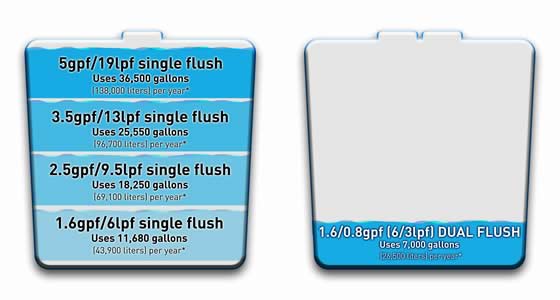
Then there was the new and improved low-flush toilet, which was better but still not what always got the job done. And finally, the High-Efficiency toilet arrived; you now have your choice of flushing as little as .8 gallons with dual flush toilets. The best part is that they really work!

What Are High-Efficiency Toilets?

Under federal law, toilets must not exceed 1.6 gallons per flush (gpf). High-efficiency toilets (HETs) go beyond the standard and use less than 1.3 gpf. The WaterSense label will be used on HETs that are certified by independent laboratory testing to meet rigorous criteria for both performance and efficiency. Only HETs that complete the third-party certification process can earn the WaterSense label.

 Do High Efficiency Toilets Work?

Everyone is concerned about the performance of low-flow toilets. Do they clear the bowl and leave it clean? Do they stop up frequently? Unlike the first 1.6 gallon / flush toilets, WaterSense HETs combine high efficiency with high performance. Advances in toilet design permit WaterSense HETs to save water without loss of flushing power. In fact, many perform better than standard toilets in consumer testing. Want proof? Watch this amazing video of Eddie Wilcut, the Water Conservation Manager for the City of San Antonio, flushing a Russet potato down a Caroma toilet with the full flush (1.6 gallon) AND half flush (0.8 gallon), which is meant for liquid waste.

How Much Water and Money Do HETs Save?

High efficiency toilets save you money by reducing your water and wastewater costs. Over the course of a lifetime, an average person flushes the toilet nearly 140,000 times. If you install a WaterSense HET, you can save 4,000 gallons per year and your children can each save about a third of a million gallons during their lifetime. If a family of four replaces one 3.5 gpf toilet made between 1980 and 1994 with a WaterSense toilet, they can save $2,000 over the lifetime of the toilet. If the toilet being replaced was made before 1980, it uses 5 gallons per flush so the savings will be much greater. If you’d like to calculate how much water you can save try the water savings calculator on www.ecotransitions.com.

With these savings, new high-efficiency toilets can pay for themselves in only a few years. Even better, many local utilities offer substantial rebates for replacing old toilets with HETs. Detailed information on the rebates available in Georgia can be found here Rebates in Georgia

What are Dual Flush toilets?

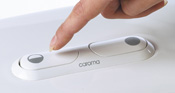
Dual flush toilets offer a patented dual flush technology consisting of a 0.8 Gal flush for liquid waste and a 1.6 Gal flush for solids. They can save up to 40% (approx. 4600 gallons) compared to today’s standard 1.6-gallon single flush toilets. On an average of 4/1 uses a day,  Dual Flush toilets have the lowest water consumption of all – 0.96 Gallons per flush. Caroma, an Australian manufacturer that invented the Dual Flush technology manufactures award winning toilets that are both user friendly and, with a full 3.5″ trap way, virtually blockage-free!  Wouldn’t that be nice to be able to finally kiss the plunger good bye? Beware of some products reducing the amount of water flushed to use with your existing toilet. Existing bowls are not designed to perform with reduced amounts of water, so the likelihood of clogging your toilet while you are trying to flush paper and solid waste increases drastically.

 

Select a WaterSense Labeled High-Efficiency Toilet!look for watersense label
Whether you are remodeling a bathroom, beginning construction of a new house, or just want to replace an old, leaky toilet, a WaterSense labeled HET is your best bet. Look for the WaterSense label on any toilet you buy. If every home in the United States replaced just one old toilet with a new HET, we would save almost one trillion (spelled with a T)

gallons of water per year, equal to more than two weeks of the water flowing over Niagara Falls!

Note that some manufacturers offer high-efficiency and ordinary models with very similar names, so be sure and look for the WaterSense label. A list of WaterSense labeled High-Efficiency Toilets can be found here List of WaterSense labeled HET’s published by the EPA.

Where can I find a HET?

To find WaterSense partners and resources in your area, please follow the link and click on your state below or choose from the list that follows. EPA – Where you live

For a watersavings calculator and more information on Dual Flush toilets please visit www.ecotransitions.com.

WaterSense Partners helped save 277 million gallons of water in 2007

10 drinking water scams exposed

The following information was provided by Pete Van Cleave, Water for Life http://www.waterforlifeonline.com/

Everybody is susceptible to being scammed, simply because they want to believe!

Nowhere is this more obvious than in the drinking water business. Politics spawns a lot of lies in the water business since the government is responsible for making tap water. Franchising and exclusive territories also spawn lies.  The internet has spawned much nonsense, too, with it’s uncensored, wild west sort of approach to business. It is truly alarming to see the explosion of internet products claiming to infuse water with magical properties to cure all your ills. These specially altered waters claim to be superior because they’re wetter, oxygenated, clustered, enhanced, magnetized, energized, alkalized, vitalized, or some other pseudoscientific term.  These empty promises simply do not hold water.

We always look for scientific and verifiable data from reliable third parties than can provide the proven facts about the various treatment technologies and how pure water works to support good health.  Education is the only way to battle bogus claims. I have studied water for 20 years and I stand firm in my commitment to bring you the very best possible drinking water and water purification systems based upon the best information available.

Distillation is the only method to produce legally purified water

Since 2002, it is one of three methods to produce legally purified water.  Competitors only selling one thing tend to defend it well, but also get their blinders on regarding other advances.  Biopure Everclean Reverse Osmosis also produces microbiologically pure water according to the NSF without electricity. We believe independence protects consumers best.

Common Reverse Osmosis works as well as NSF Nano filter/Everclean Rinse Reverse Osmosis

Common Reverse Osmosis systems degrade from day one like a filter does. Microbiological contaminants often migrate through the membrane or o-rings. Everclean Rinse Reverse Osmosis prevents the membrane from degrading and keeps the water 100% consistently pure. It costs more, but the value is there because the membrane does not have to be replaced like it does with common RO.  The NSF Nano filter technology gives a non electric system barrier protection against all forms of bacteria for those undergoing chemotherapy, organ transplant, or HIV/Aids.

Throwaway bottles are not a problem because they break down in the landfill.

There is an area of floating plastic trash in the Northern Pacific ocean that is twice the size of the continental United States. Experts tell us that dangerous chemicals from industrial waste stick to the plastics and enter the food chain as it is ingested by birds and marine life.  Americans bought about 50,000,000,000 plastic bottles in 2006 and the cost of energy and pollution is staggering! It takes enough crude oil to fuel 100,000 cars for a year to make a year’s supply of those plastic bottles. It takes 1000 years for these bottles to break down 100%.

Energized, vitalized, living, hexagonal, activated, ionized, and restructured water is purported to slow aging, restore cellular balance, or raise consciousness, and promote world peace.

All scams and hoaxes supported by testimonial evidence which only tries to take advantage of feel good placebo marketing. Absolutely no third party testing or science supports this.

 Oxygenated water enhances performance and post recovery workout.

The grossly overpriced Penta water is priced at $15.00 per gallon.  Perfect water by Amway is priced at $36.00 per case. Infused with 30- 40% more oxygen than ordinary water, it is marketed on the premise that the body can actually absorb oxygen directly into the bloodstream via the digestive system. The only way to get oxygen into the blood is through the lungs.  Trying to get oxygen into your body from water is called “drowning”! Unless you have gills, there is no need to search out water with extra oxygen.  This is a case of pure fraud without physiologic foundation.

 Clustered water is the fountain of youth.

Each year, university researchers on human aging bestow their annual “Silver Fleece” award on anti-aging quackery.  The 2002 recipient was “clustered” water. Water only really clusters when it crystallizes during freezing.

Magnetic water can cure all manner of human ailments.

There is no scientific evidence that water can even be magnetized in the first place.  This scam is at odds with the fundamental laws of physics.

Advanced filters can protect you as well as legal purifiers

Filters do not protect against microbiological or inorganic contaminants. They are often not changed properly, they break down, they dump, they channel, and they produce a declining level of performance the older they get. I often test the water coming out of them worse than the water going into them because they have no automatic shutdown devices.

 Cheap spring or national brand water in 16.9 oz bottles is the answer to tap water problems.  

Teton Springs, Quibell, Lithia Springs, and Big Springs are all local springs that have gone out of business in Georgia in the past 15 years because they failed to protect their customers from microbiological contamination in their water. Crystal Springs, Dasani, and Aquafina have all been cited for contaminants in their water in the past 8 years. We have tested our water against Deer Park, Zephyr Hills, Nestle Pure Life, Crystal Geyser, and every cheap brand sold in the state of Georgia. They all test out with contamination higher than tap water.

Municipal water systems are still keeping our drinking water safe.  Every system using chlorine contains the cancer causing agent trihalomethanes.  63% of waterborne illnesses in the U.S. are directly caused by Cryptosporidium and Giardia cysts, which are city water chlorine tolerant.  Flouride is ineffective and has serious health risks.  The American Dental Association is now warning parents not to use fluoridated water in the preparation of formula. After so many “boil water” alerts, chemical spills, broken water mains, and now AP’s pharmaceutical expose, Municipalities and states are now spending $63 billion dollars a year to try to keep up, but they can’t.  Legal testing requirements and repairs are currently routinely granted waivers. Many municipalities are using the exact same technology that has been in place for 100 years.  TDS levels, by my own testing are double what they were 20 years ago.  Standards are getting tougher as we find out new scientific facts and more contaminants are being discovered.  For example, in January 2006, the standard for Arsenic was reduced from 50 PPB to 10 PPB.  That means the previous standard was off by 500 percent! The distribution system is completely laden with problems: over 237,000 water main breaks in 2006.  The distribution system is coated with dangerous layers of mineral, biological, and chemical deposits that recontaminate the water as it travels in pipes from treatment plant to homes.  We now have over 2100 chemical contaminants in the drinking water that we can test for but we don’t. The EPA estimates there is a gap of $22 billion per year between what is needed and what is done. The fact is that in the next 30 years, every city water supply in the U.S. will reach or exceed it’s expected lifetime, costing the American taxpayer somewhere near $300 billion just to fix the underground pipes. 

Respectfully,

Pete Van Cleave

Water for Life

(770) 578-0600


Critical Water Shortages

Caroma Toilet Review | H2O Report

Caroma Toilet Review | H2O Report

Posted using ShareThis

Caroma was started back in 1941 by a man named Charles Rothauser, the company’s production and innovation on these toilets start back in 1945. They have been successful in their endeavors and have since produced two new urinals that have become the leaders in water saving technology. This company is based in Australia and their products have found the world over. Their products will save you money on your water bills.

By using Caroma Toilets it has been proven that you can save water up to 18,000 gallons of water every year. These toilets have proven reliability and dependability. The technology that has gone into creating these toilets is one of a kind. If you are tired of wasting water and wasting money on your water bills, then you should check out the Caroma Toilets.
One of the series of toilets that Caroma pride themselves on is their WaterSense Toilets. These toilets are considered to be High Efficiency Toilets or HET. In the United States, the federal law, all toilets must not exceed 1.6 gallons of water per flush. With Caroma, their toilets use less than 1.3 gallons of water. The Water Sense label is used on High Efficiency Toilets as they are certified to be. These WaterSense Toilets Meets the EPA Criteria.

The Water Sense Toilets are available in many different styles. Let’s take a look at the top three in the Water Sense Toilets. The Adelaide Cube 270 Easy Height Round Front Plus, Bondi 270 Easy Height Elongated and the Caravelle 270 Easy Height Elongated. Take a look at these popular Caroma Toilets and see which one would best save you money on your water bills.

The Adelaide Cube 270 Easy Height Round Front Plus
The Adelaide Cube 270 Easy Height Round Front Plus is a High Efficiency Toilet or HET. It has a 1.6/0.8 gallons per flush. It is a two-piece toilet with a two button dual flush toilet. The bowl is a higher bowl with a measurement of 16.5 inches. It also has a larger concealed trapway and it is an easy cleaning. This toilet is floor mounted and works in conjunction the connection to the waste outlet for a 10-inch to 12 inch rough in.

This Adelaide Cube 270 Easy Height Round Front Plus offers a standard bottom entry; this toilet design is available as a left-handed inlet and includes a quiet water control assembly. It also is designed with an internal overflow only. The tank is installed directly to the closet bowl with a robust base fixing system without having to do any wall fixing of your own.

The Caroma Adelaide Front Round Toilet is nearly unblockable; you should have confidence when you use the Adelaide that there won’t be any clogs. The dimensions of this toilet are 29-5/8 in length x 13-3/8 inches in width x 32-5/8 inches in height. This is a standard size toilet with a round front design. If you are looking for a new toilet, one that will save you money on your water bills then you should check out this model. The price on this toilet is about $ 600.00; you could shop around for a better price.

Bondi 270 Easy Height Elongated Bowl Front
The Bondi 270 Easy Height Elongated Bowl also has a 1.6/0.8 gallons per flush high efficiency. This toilet is made from vitreous china, which is one of the most durable materials used for manufacturing toilets. This toilet has an elongated bowl design with 17 to 19 inches in height. The adjustable rough in on this toilet is between 10 inches and 12 inches. This toilet is a two-piece, two button dual flush. A dual flush toilet has two buttons, one is actually for flushing the toilet half flush and the other is a full flush.

The benefits of having a dual flush on the Bondi 270 is that is you are flushing urine then the half flush would be perfect, it would use .08 gallons of water and for solids you would use the full flush with a 1.6 gallons per flush. Imagine how much water you will save by using half flushes. The 270 was designed with water conservation in mind. Since the bowl design is elongated you will get a more accurate flush every time.

The Bondi 270 has a free fitting lid and would work great either in a domestic situation or a very light commercial application. This toilet comes with a Vandal Resistant Conversion Kit; this is an easy to install kit that locks the lid onto the tank. If you don’t have a lot of heavy traffic at home as opposed to a commercial application then you probably don’t need it. This toilet has the WaterSense label and is ADA compliant. This toilet is priced around $550, prices vary if you shop around.

The Caravelle 270 Easy Height Elongated
The Caravelle 270 have a great European style design, they will give your bathroom that elegant yet modern look. These toilets are two-piece toilets with elongated bowl front. This toilet is a high efficiency toilet with a dual flush. One flush is used for urine and liquids, when you use this half flush you will use a .08 gallons of water per flush and when you use the full flush for solids, you will use 1.6 gallons per flush.

The Caravelle 270 Easy Height toilet has a 17 inch elongated bowl for a more accurate flush. This toilet has a large 100% concealed trapway and like the Bondi and the Adelaide Toilets these are almost unblockable. These toilets have a full flush wash down with a closet bowl and an open flush rim. It can be floor mounted suitable for a connection to the waste outlet with a 10 inch to 12 inch rough in.

This tank is also a free fitting lid and a Vandal Resistant Conversion Kit is available. It is not recommended for residential homes. The Caravelle has a standard bottom entry tank that is available as a left hand inlet that includes a very quiet water control assembly. This toilet costs about $ 451.00 and you could find a cheaper price if you shop around.

Caroma Toilets have been around for since 1945, they are not considered to be mainstream toilets like American Standard, Kohler or Delta but they have a reputation for being high quality, high performance toilets with a water conservation design. You can purchase these toilets from certain distributors. If you are interested in taking a look or getting more information on other Caroma Toilets, log onto their website and check out the Where to Buy button, click on the map and find a dealers nearest to you.

If you have any questions, you can click on their Contact Us link and find the nearest customer service number to you. Caroma will answer any questions that you may have. They have quality products and they will surely last you a long time. They will also save you money every month on your water bills. If you are looking for a new toilet that will save you money rather than cost you money, Caroma Toilets should be considered. They have a full inventory of great products.

Agencies adopt water diets – SignOnSanDiego.com

Soenso Celebrates Five Years of Providing Clean, Renewable Energy to Georgia

Solar PV Array on Roof of Campus Crossings Emory University

Solar PV Array on Roof of Campus Crossings Emory University

Source Press release, September 30, 2009

ATLANTA, GEORGIA, September 30, 2009 – Founder and president of Soenso Energy, Roger K. Cone, today announced that this Marietta, GA, startup is celebrating five years of service to Georgia. Established in September 2004, Soenso Energy is one of the leading renewable energy installers in the state. Soenso, which is an acronym for Southern Environmental Solutions, installs commercial and residential solar thermal water heating, solar photovoltaic (PV) electric and small wind turbine electric systems.

“Much of Georgia is marginal for wind energy,” said Mr. Cone, “but there are micro-climates in our area where our residential/small commercial-sized wind turbines perform quite well. However, Georgia is indisputably a solar state.” Most of Georgia is rated as “very good” for solar radiation according to the U.S. Department of Energy’s National Renewable Energy Laboratory (NREL). Georgia is on par with much of Florida, the self-proclaimed “Sunshine State”, for solar energy potential.
Currently there are generous Federal and Georgia financial incentives in place for the installation of renewable energy. Generally speaking for commercial solar or wind energy installations the Federal incentive is a 30% income tax credit or grant, and the Georgia incentive is a 35% income tax credit or rebate. And generally speaking for residential solar or wind energy installations the Federal incentive is a 30% income tax credit, and the Georgia incentive is a 35% income tax credit. There are published maximum limits on Georgia renewable energy incentives.

In its “long” five-year history Soenso has provided renewable energy systems for clients in a variety of categories including churches, inns, museums, office buildings, private residences, restaurants, schools and warehouse facilities, among others. Soenso Energy encourages the practice of energy conservation first and then the implementation of renewable energy. We are helping Georgia move away from our dependence on dirty fossil fuels such as petroleum and coal that are major contributors to the climate crisis. Soenso Energy is working toward making renewable energy a more significant component of Georgia’s overall energy mix.
About Soenso Energy Located in Marietta, Georgia, near Atlanta, Soenso Energy is a supplier and installer of commercial and residential renewable energy products – solar thermal hot water systems, solar photovoltaic (PV) for generating electricity and small wind turbines for generating electricity. These renewable energy technologies qualify for Federal and Georgia clean energy income tax credits. On the Web: http://www.soenso.com , Email: info@soenso.com, Phone: (770) 973-6298.

please vote for Soenso Energy

Soenso Energy.

Please vote for Soenso Energy to win a free website by an interactive marketing  agency based in Atlanta, Solar Velocity.
Soenso Energy, founded in 2004, is one of the pioneering renewable energy integrators in Georgia. They are a family owned and operated business; managed by brothers,  Roger and Charles Cone. Soenso Energy, founded in 2004, is one of the pioneering renewable energy integrators in Georgia. When Soenso started five years ago, there were no more than a half dozen solar installers in the entire state. Now there are more than three dozen solar installers in Georgia. With this plethora of newcomers they find it increasingly more difficult to maintain high search engine rankings with their current Web site. A professionally designed and optimized Web site from Solar Velocity would be a great enhancement toward helping them to continue to grow their business and to supply clean, renewable energy to Georgia; They sell and install high quality German- designed solar photovoltaic (PV) systems and solar thermal water heating systems and high quality American-designed wind turbines. They are also confident that they have the best installation crew in the state of Georgia.
Please give them your vote here

Speaking of Green by SouthEast Green with ecoTransitions

Walpole Sewer and Water Department rebates and giveaways – Walpole, MA – Wicked Local Walpole

In brief – Winnipeg Free Press

Save Water While Saving Money—Georgia Sales Tax Holiday Features WaterSense® Labeled Products

If you’re planning to buy a toilet or bathroom sink faucet this fall, timing your purchase to coincide with Georgia’s sales tax holiday for WaterSense labeled products can help you save a little money. Between October 1 and October 4, 2009, customers will not have to pay sales tax on toilets and bathroom sink faucets and accessories that have earned the WaterSense label. Consumers can be sure that products with the WaterSense label have been independently certified to meet the U.S. Environmental Protection Agency’s (EPA’s) rigorous criteria for water efficiency and performance. 

Purchasing and installing WaterSense labeled products is a key way Georgians can save water. If just one out of every four households in Georgia would retrofit their bathrooms with WaterSense labeled bathroom fixtures, it could save nearly 10 billion gallons per year—enough for every Georgian to take a shower daily for about two months. 

Whether remodeling a bathroom, constructing a new home, or simply replacing older, inefficient fixtures that waste money and water, consider installing a WaterSense labeled toilet or bathroom sink faucet. 

As consumers shop for WaterSense labeled toilets during the sales tax holiday, they can be sure these fixtures use 20 percent less water than the current federal standard for toilets and that WaterSense labeled bathroom sink faucets and accessories will reduce a sink’s water flow by 30 percent or more. Because all products must be tested to meet EPA’s criteria before earning the WaterSense label, these water savings are achieved without sacrificing performance. 

The sales tax holiday on WaterSense labeled products will start Thursday, October 1 at midnight and will continue through the weekend until 11:59 p.m. on Sunday, October 4.  Any WaterSense labeled product purchased for noncommercial home or personal use during the sales tax holiday will be Georgia state sales tax-free. 

For more information on the sales tax holiday, visit Conserve Water Georgia.

For more information on WaterSense, please visit www.epa.gov/watersense

For more information on WaterSense labeled, High Efficiency Toilets, please contact GA’s largest seller of the award-winning Caroma Dual Flush toilets, ecoTransitions. All of Caroma’s 47 floor mounted models also qualify for the $100 toilet rebate offered by most Metro Atlanta Water authorities. For more information, visit http://www.ecotransitions.com/ or contact them via email at sales@ecotransitions.com or by phone at (678) 313-9260. ecotrans_watersense_partner logo

Sales Tax holiday in Georgia October 1-4, 2009

October 1-4, 2009

A culture of conservation is growing in Georgia.

We are responsible for the stewardship of our state’s natural resources. Incorporating energy and water conservation practices into our daily lives benefits everyone in our state now and for generations to come. And small changes can make a big impact in our pocketbooks. To help make those changes a little easier, Georgia is offering the ENERGY STAR® and WaterSense® Sales Tax Holiday, Oct. 1-4, 2009.

During the sales tax holiday, you can purchase ENERGY STAR-qualified or WaterSense-labeled products up to $1,500 without paying sales tax. In addition to the up-front cost savings, purchasing and installing more-efficient appliances and products can reduce in-home utility costs and improve both energy and water conservation.


ENERGY STAR®

ENERGY STAR products meet strict energy efficiency guidelines set by the U.S. Environmental Protection Agency and U.S. Department of Energy. These appliances, electronics and lighting operate while using less energy – and less money – than older models.

Americans, with the help of ENERGY STAR, prevented 43 million metric tons of greenhouse gas emissions in 2008 alone – equivalent to the annual emissions from 29 million vehicles – and saved more than $19 million on their utility bills. By looking to ENERGY STAR for best practices and products, households can reduce their energy use and save about one-third, or $750 annually, on their utility bills, while reducing greenhouse gas emissions.


WaterSense®

WaterSense, a national program sponsored by the U.S. Environmental Protection Agency, makes it easy to find water-efficient products. Toilets, faucets and other products that are independently certified to meet U.S. EPA criteria for water effi­ciency and performance can earn the label.Look for WaterSense labeled products

The average household spends as much as $500 per year on its water and sewer bill. By installing WaterSense-labeled fixtures and ENERGY STAR-qualified appliances that use water more efficiently, a household could save about $170 per year. If just one out of every four households in Georgia retrofit their bathrooms with WaterSense-labeled fixtures, it could save nearly 10 billion gallons of water per year – enough for every Georgian to take a shower daily for about two months.

For more information on ENERGY STAR, please visit www.gefa.org/Index.aspx?page=352

For more information on WaterSense, please visit www.conservewatergeorgia.net/documents/ waterSense_taxHoliday.html

$60: City eyes credit for installing dual-flush toilets – Winnipeg Free Press

The Origins of the Toilet

via The Origins of the Toilet.

Why do some people call a toilet a John?
According to countless resources the reason some people have tagged a toilet with the name John is simply because the first recorded inventor of flush toilet is John Harrington. John Harrington was a descendant of Queen Elizabeth the first.

What are the origins of the word toilet?
The french were the first to use the word toilet almost three centuries ago. The word like countless other words is Latin. The word derives from tela or plural tele which means cloth. French barbershops used the word toilette to describe the grooming activities typically associated with the barber shop. In the US the word later evolved into the device which we use to flush our waste in the bathroom. However it is not uncommon in Europe to hear the word toilet being associated with what we know as the bathroom as a whole.

What is a commode? Why is a commode associated with the word toilet?
Well commode a few centuries ago in France just meant a cabinet that is close to the ground or a chest with drawers. During the Victorian Era commode took on a whole new definition. The people of the Victorian Era had bedside cabinets that enclosed a chamber pot or in other words pot that was used for the basic needs of a toilet. Except of course it did not flush.

Why do some people call a water closet a toilet?
It is common to see the word water closet used on blueprints for homes. In this context it typically means a standard toilet. The word water closet simply means, “room with a toilet.” Water closets were originally separate from the bath room. Bath room originally meant a room with a bath in it. The first public water closet was a pay per use toilet. The customers were charged one penny to enjoy the luxury of a flushing toilet. This is where the motto “to spend a penny” came from.

What is a loo?
The origins of the word loo are not exactly known. However it is believed to come from the french. In the early days before flush toilets and indoor plumbing the French would dump their waste out the window, exclaiming, “Gardez l’eau”. This meant look out for water. The word l’eau sounds like the word loo.

Why do some people call a toilet, “a head”?
The word head is commonly used on boats. It is called a head because it was placed at the front of a boat. The front of the boat is where the most splashing from the seas occurs. This would allow the head or toilet to receive a well needed cleansing or flush.

Where does the term lavatory come from?
Lavatory, has it beginnings in Latin from the word lavare meaning wash. If you speak Spanish you know that lavarese means to wash. The word lavare evolved over time to mean lavatory which some consider a proper way to say bathroom. Bathroom which is commonly know to enclose a toilet as well a place where you can wash.

bathroom toilets can be a drain on your finances. A dual flush toilet saves a great deal of water resulting in a significant cost decrease in you water bill . Next time you buy a toilet, choose a water saving one.

Who’s To Blame For The Great Pacific Garbage Patch? Look In The Mirror.

The slowly moving, perpetually undulating mass of pastel and primary colored plastic trash that bobs up and down in the middle of the ocean is perhaps one of the biggest man made eyesores of its …

Posted using ShareThis


The slowly moving, perpetually undulating mass of pastel and primary colored plastic trash that bobs up and down in the middle of the ocean is perhaps one of the biggest man made eyesores of its kind aside from the infinite landfills of rotting post consumer waste that continue to dot our landscape. We’ve seen photos and video footage documenting the existance of this aquatic nightmare and every single one of us probably understands the correlation between our consumer obsession with plastic and what happens when we discard the temporary fixtures of our lives. For years, human beings have purged ships and boats of their excess plastic waste. We’ve conveniently forgotten to clean up after ourselves following long, lazy days at the beach. Countless plastic shopping bags, one-time-use plastic water bottles and beverage caps have been wind-swept from the pavement (where we dropped them) into overflowing sewage systems or carried there following rain storms.

go8f4013-copy.jpg

Our rational minds may tell us that a state-sized mass of plastic trash does not belong in the middle of the ocean and our mouths may even fall agape at the sight of hard to fathom images of the chunky plastic buouyant soup. In spite of the shock that may radiate through our systems, every single one of us is to blame for the Great Pacific Garbage Patch’s existance. Scoff if you will. Cling onto the fact that you are a diligent recycler — go ahead and pound your chest while proudly declaring that you gave up bottled water one year ago and that reusable bags are your thing. You can itemize all of the personal efforts you’ve made to positively impact the environment but the bottom line is that the Great Pacific Garbage Patch is the result of society’s carelessness, and as a member of the human race, every single one of us is to blame.

JA_GarbageSoup_003.jpg

There is now so much plastic waste clogging the ocean 1,000 miles north of Hawaii that scientists estimate it is now about twice the size of Texas. This is hardly accidental, unless you consider apathy and outright littering a chronic mistake that has been coincidentally repeated ad nauseum by the large majority of our population. Perhaps it is a symptom of our cultural ignorance or it demonstrates the general lack of regard that humans have for what happens beyond our own small sphere.  How many times have you or someone else you know uttered such phrases as: “I’m too busy.” “It’s not my fault in the first place.” “Let someone else deal with it.” “I’ve never thrown out a single piece of plastic in my life, so don’t look at me.” “There’s no recycling service in my neck of the woods.” “I don’t live in the middle of the ocean, so why should I care?”

image.jpg

 Not only is it our problem, we’ve got to stop passing the buck and presuming that someone else will take care of this mess. It may be unreasonable to suggest that everyone should start paddling out into the middle of the ocean on their weekends and dragging as much plastic trash as they can back to the mainland for proper recycling — that job is perhaps best left to marine scientists who must figure out how on Earth they can resolve this ecological problem as effectively as possible. In the meantime, we can’t allow these images to fade from our minds because they serve to remind us that our daily eco-friendly efforts can make a huge difference. Stay away from non-recyclable plastic products and make sure that every single piece of plastic that does enter your household leaves in a recycling container or is repurposed in a responsible manner. Pick up plastic “junk” that is discarded in public places and relocate it to a proper recycling bin. Shift your household over to more eco-friendly alternatives such as glass, wood and ceramic. Stop thinking that recycling one bag or cap is not going to make a difference. Clearly, it all adds up over time…just take a good long look at what is clogged in the middle of the ocean for all the proof that you’ll ever need.

The Top 10 Facts About the Great Pacific Garbage Patch:

  1. Each year, 10% of the 200 billion pounds of plastic produced globally ends up in our oceans and now, roughly 46,000 pieces of plastic litter are floating on every square mile of the ocean.
  2. A 1,700 mile mass of plastic garbage sits in the middle of the North Pacific Subtropical Gyre, a slowly moving, clockwise spiral of ocean currents.
  3. The gyre actually consists of two large masses of ever-accumulating trash, the Western Pacific patch (located east of Japan and west of Hawaii) and the Eastern Pacific patch (floating between Hawaii and California).
  4. Both zones form what is referred to as the Great Pacific Garbage Patch and they are connected by a thin 6,000-mile long current called the Subtropical Convergence Zone.
  5. The mass moves seasonally as much as a thousand miles North and South in the Pacific while in warmer El Nino periods, it drifts even further South.
  6. Approximately 3.5 million tons of plastic waste can be found in this water-bound waste zone.
  7. 90 percent of all trash floating in the world’s oceans is plastic-based and some of the most common items found in the Great Pacific Garbage Patch include toothbrushes, wrappers, bottle caps, plastic shopping bags, pacifiers, old toys, fishing floats, soda bottles, Styrofoam chunks, tangled nets and even patio chairs.
  8. The plastic pieces in the Great Pacific Garbage Patch contain toxic elements able to absorb other chemicals such as DDT and PCBs, and these components can persist in the environment for decades.
  9. 100,000 marine mammals each year — such as sea turtles, seals and birds — are the victims of plastic trash-related deaths because they consume or become entangled in the waste.
  10. There are up to six pounds of marine litter for every pound of plankton in the ocean.

Toilet rebate in Seattle, WA – only during the month of September 2009

Source Komo News

Pay close attention to your water bill. A new rebate program could mean extra money in your pocket.

Seattle Public Utilities is partnering with 17 local water districts and six local retailers in a program aimed at conserving water and helping consumers save money.

September water bills include a $30 instant rebate coupon for replacing water-guzzling toilets with newer high-efficiency models.

Only certain toilets qualify. They must carry an EPA WaterSense label and use only 1.28 gallons per flush.

Turns out more than half the households in this area – 52 percent – still have toilets that use twice the water needed to do the job.

Toilets made before 1982 use 5 to 7 gallons per flush (GPF). Toilets made from 1982 to 1993 use 3.5 gallons. In 1994 the requirement dropped to 1.6 gallons.

The 1.28 GPF models have been around since about 2006.

Depending on your water and sewer rates, switching from a high GPF toilet to a high-efficiency 1.28 GPF model can lower your water bill by $30 to $100 a year- maybe even more.

According to Seattle Public Utilities, a Seattle family of four who flushes 20 times a day with a 3.5 GPF toilet pays $420.58 a year. With a 1.28 GPF model, the bill drops to $160.81 for an annual savings of nearly $260.

The rebate program runs through the month of September.

For participating water districts and retailers, click here.

Water conservation’s zenith

Water conservation’s zenith

Shared via AddThis

Toilet with built-in sink earns top marks

By Vanessa Farquharson, Canwest News ServiceAugust 21, 2009

If you live in a small space and are thinking about investing in a dual-flush toilet, hold on to your money for another month because there’s a new water-conserving toilet in town and, as water-conserving toilets go, it’s to die for.

The Caroma Profile Smart 305 doesn’t just offer the choice between a full six-litre flush for solids and half that for liquids, it also comes with a sink perched on top. The leftover water from hand washing and tooth brushing is drained straight into the toilet tank, where it’s held until the next flush.

Yes, this means flushing your business down the toilet with old, soapy and, possibly, toothpastey water, but it’s going straight down the drain anyway and means that barely any fresh water is required.

“The concept was developed in Australia, which is the best in the world when it comes to water conservation,” says Rich Armstrong, head of Armco Agencies, the distributors for the Caroma toilet in Eastern Canada. “I was actually contacted by the Australian consulate about seven years ago to look into dual-flush toilets . . . We’ve had this particular model featured in two or three showrooms now and the phones have been ringing off the hook.”

Armstrong says the Caroma will see its first shipment in mid-September, and predicts it will be most popular with those living in small apartments or condos.

“Water conservation is one thing, but a lot of bathrooms don’t have space for both a toilet and sink,” Armstrong says, “so this model works well for those kinds of restrictions. It’s pretty unique.”

It has also won a handful of awards already, including the Popular Mechanics Breakthrough Award for innovative design and engineering

re-source: A fresh approach to bottled water, or not? : TerraCurve.com – Go beyond green. | Responsible travel news, places, people and events.#comment-15227964#comment-15227964

Canada, BC: Comox Valley Regional District Goes Low Flow with Toilet Rebate Program

Source: British Columbia News, www.comoxvalleyrecord.com

The Comox Valley Regional District (CVRD) will launch a toilet rebate program by the end of September as part of the plan outlined in the draft water efficiency strategy intended to achieve a 27 percent reduction in water consumption by 2014.

The Comox Valley Regional District wants to help toilets help the environment.

A toilet rebate program will be launched next month, as part of their draft water efficiency plan designed to achieve 27-per-cent reduction in water consumption by 2014.

“This is a fabulous opportunity for the CVRD to reduce both water consumption and sewage flows,” said Fred Bates, CVRD board chair. “Using less water per flush will both conserve our valuable resource and save us all money in the long run.”

For residents replacing an old water-guzzling toilet in residences built prior to Jan. 1, 2005, the CVRD will offer homeowners, property managers and plumbers a $75 rebate — one rebate per single-family home — for installing water-efficient toilets.

The rebate program applies to installations connected to the Comox Valley water system including the Town of Comox, City of Courtenay and the Arden, Comox Valley, England Road, Marsden/Camco, and Greaves Crescent water local service areas.

Toilets using 13 litres or more per flush must be recycled and replaced with a CSA-approved new low-flow model accompanied by a receipt dated after Aug. 15, 2009 to be eligible for the $75 rebate.

A recycling receipt for the old toilet must be obtained.

Initially, old toilets can be returned to the Comox Valley Waste Management Centre, open 8:30 a.m. 5:30 p.m.

Applications will be available by the end of September from the CVRD, City of Courtenay or Town of Comox offices or by visiting www.comoxvalleyrd.ca.

Applications will be processed on a first-come, first-served basis while the funding lasts.

— Comox Valley Regional District

Official Food, Inc. Movie Site – Hungry For Change? – Spread the Word

Advertisement in Brazil encourages urinating while taking a shower to save water

Source http://www.greenlaunches.com/

An animated video ad has been released in Brazil encouraging people to urinate in showers to save water. It has been aired on TV and has many characters including, Mahatma Gandhi, King Kong, Statue of Liberty, an alien and many others relieving themselves behind a semi-transparent shower curtain. SOS Mata Atlantica commissioned this ad, which is a green group that is devoted to protecting the Atlantic rainforest of which presently on 12% is currently there. Check out the video here